A low-risk pancreatic cyst isn't no-risk. And five years may not be long enough.
The abdominal imaging literature, read for you
Almost every abdominal CT or MR we read has a small pancreatic cyst on it. Most are low-risk, so we tell the team to watch and wait. But for how long, and when is it safe to stop; that’s the contested part, and this paper goes after it directly.
The guidelines don’t agree. AGA says you can stop at five years if the cyst stays stable. ACG says keep going while the patient is still a surgical candidate. The ACR pushes follow-up out to nine or ten years. It’s mostly expert opinion, because the long-term data have been thin. This study tries to fill that gap.
It’s a retrospective cohort from Mass General Brigham, ten hospitals. They pulled 6,064 adults with a low-risk cyst out of almost half a million scans: no high-risk stigmata, no worrisome features. Mean age 66, three-quarters of the cysts subcentimeter, followed for just over 20,000 person-years.
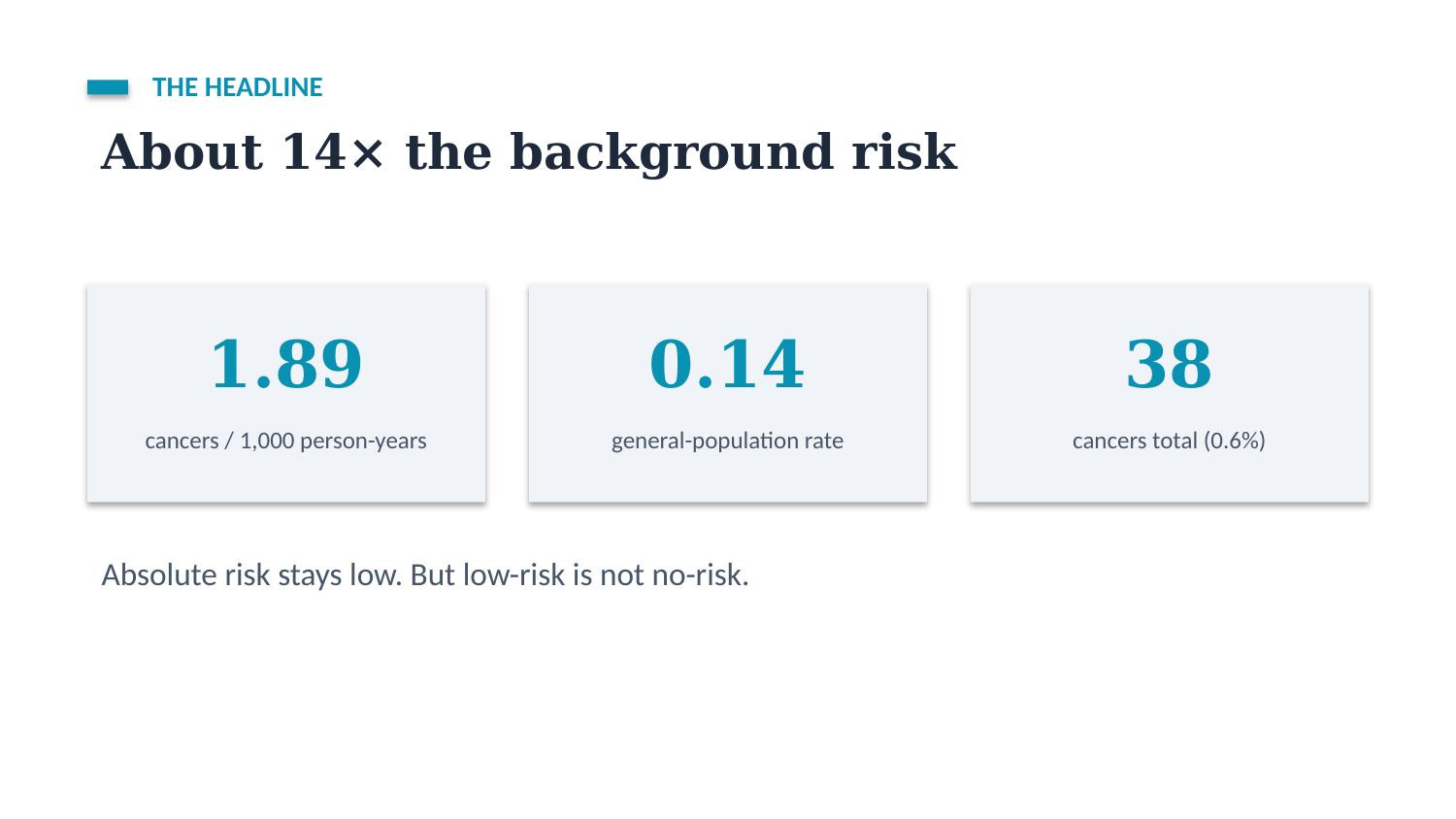
The headline number. Cancer incidence was 1.89 per 1,000 person-years, against 0.14 in the general population. Roughly 14 times higher. The absolute risk stays low, 38 cancers, 0.6 percent, so nobody needs to panic. But low-risk is not no-risk.
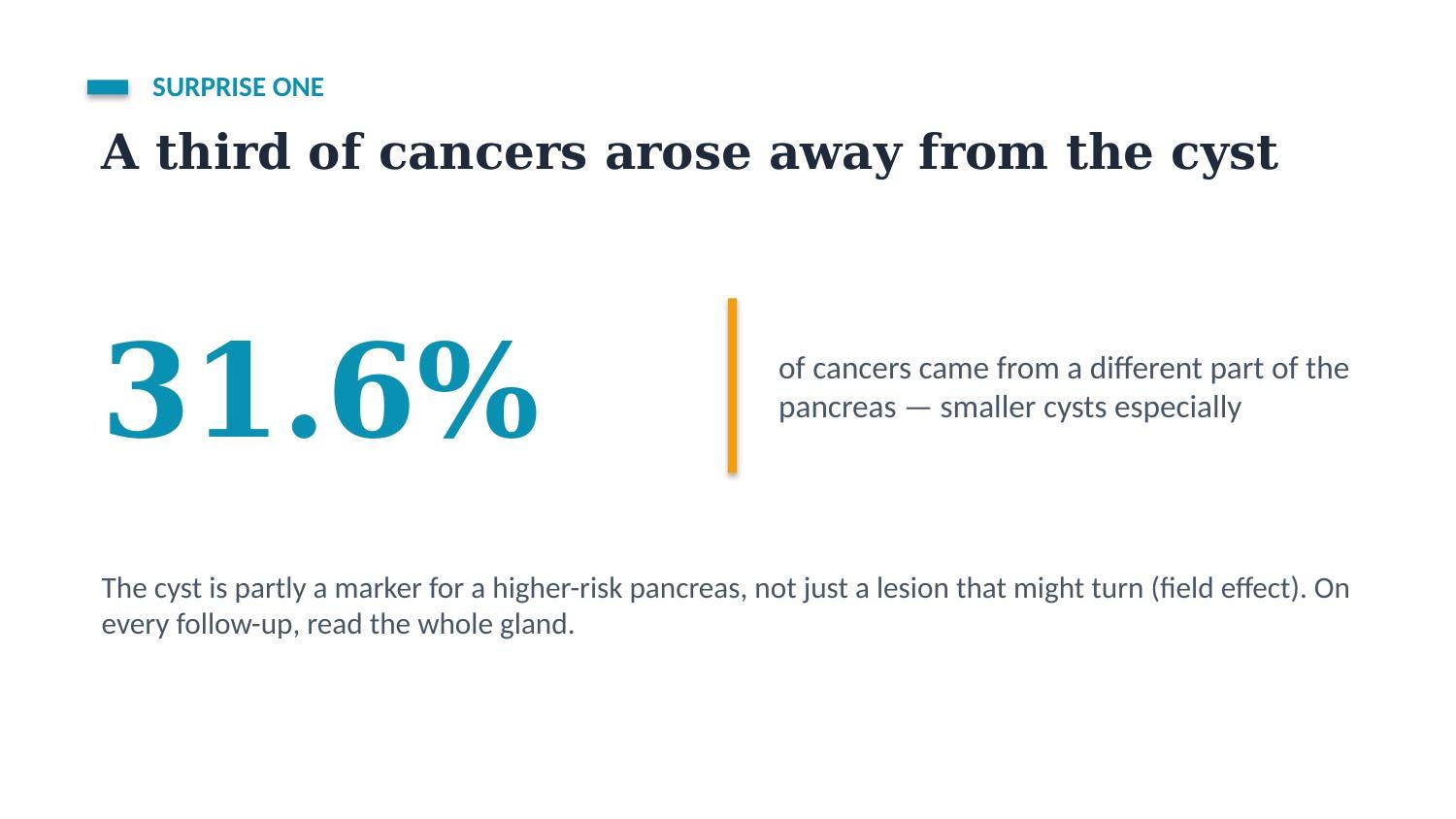
Two findings actually change how you read. The first one surprised me. About a third of the cancers, 31.6 percent, did not come from the cyst, they came from a different part of the pancreas. And the smaller the cyst, the more likely the cancer was somewhere else. So the cyst is partly a marker for a higher-risk gland, not just a lesion that might turn. On every follow-up, read the whole pancreas, not only the cyst you’re tracking.
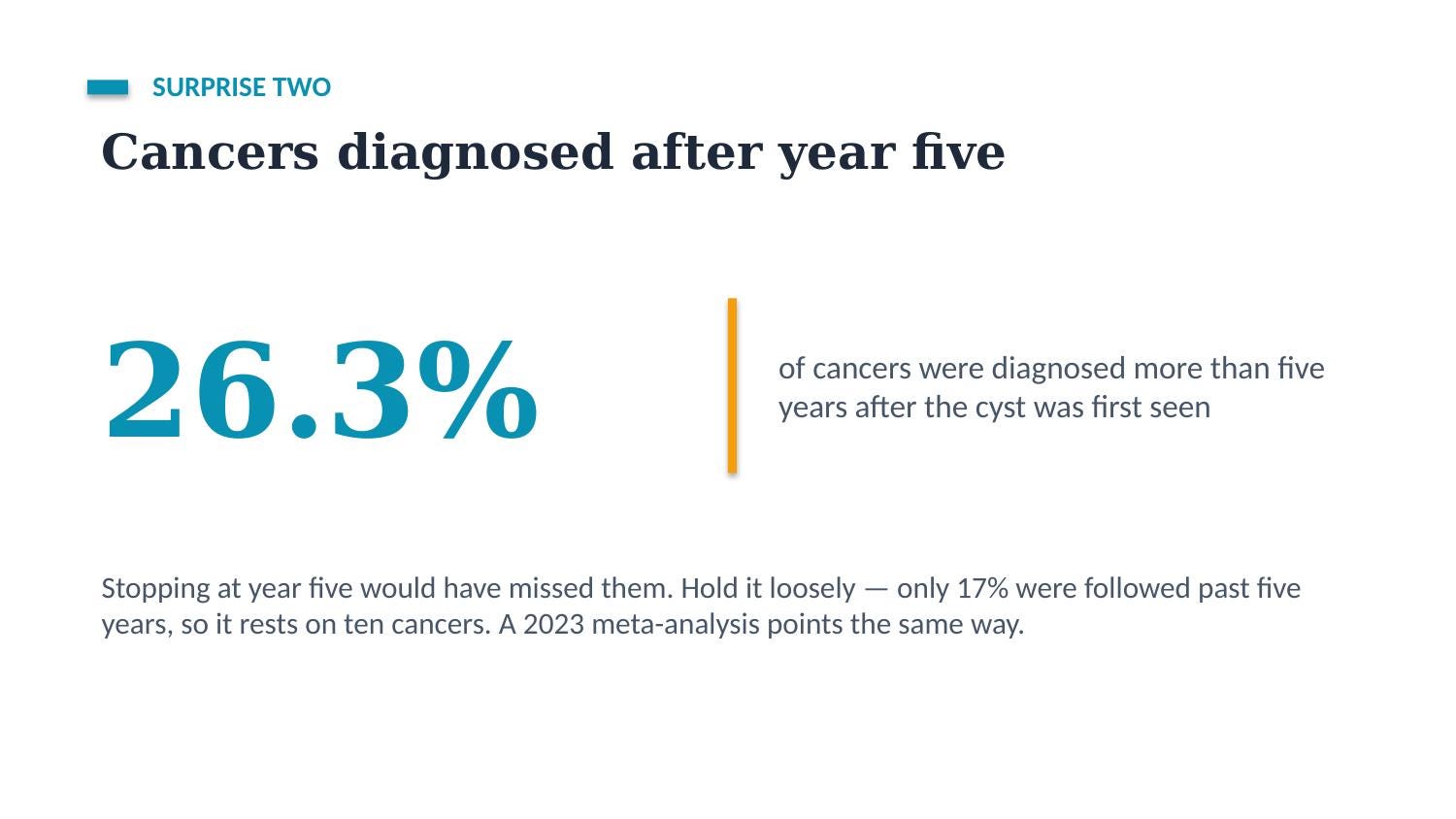
The second one hits the five-year cutoff. About a quarter of the cancers, 26.3 percent, were diagnosed more than five years out. So the guideline that lets you stop at five, AGA, would have missed them. I’d hold this one loosely, because only 17 percent of the cohort was followed past five years, so it rests on ten cancers. But a 2023 meta-analysis points the same way, so it’s not a lone signal.
Then there’s what you can actually use at report time. Size, duct ectasia, and age each tracked with cancer, but the size signal was really the two-to-three centimeter group, one to two centimeters was no different from subcentimeter. The useful move was adding age to size. Size alone barely sorted these patients, a C-statistic of 0.57. Add age and it jumped to 0.71. You already have both numbers, so use them together.
So where does this land. The shift is away from watching one cyst and toward stratifying the patient, by size and age together. But the answer isn’t clear-cut. Almost all of these patients, 99 percent, never developed cancer, and longer surveillance carries a real cost, to the system, and to the patient living under a “might be cancer” scan for years. There’s no cost analysis in this paper. It’s a single health system, mostly White patients, with short follow-up. So I read it as one argument to rethink the five-year stop, weighed against the rest of the evidence and the burden, not the last word.
I’m Melina Pectasides, and this is RadBrief.
Reference block — low-risk PCL follow-up
Screenshot this.
Largest cyst: location + max diameter (flag the 2–3 cm band)
Main duct caliber (ectasia = 3–5 mm; >5 mm is no longer low-risk)
New worrisome feature: nodule, wall thickening, abrupt duct cutoff
The rest of the pancreas, explicitly, a third of cancers arise away from the cyst
Age, as part of the risk read
Sample impression:
Stable [size]-cm low-risk pancreatic cystic lesion, [location], no worrisome features. Main pancreatic duct normal. Remainder of pancreas without focal mass. Given patient age and cyst size, continued surveillance is appropriate; discontinuation at 5 years should be individualized.
Surveillance guidance — the duration question
This is the stance, not the protocol. Confirm exact intervals against the live guideline before quoting them to a referrer.
AGA 2015: Yes. Discontinue at 5 yrs if no change. The cutoff this paper questions most directly.
ACG 2018: No. Continue while the patient is surgically fit; stop only when no longer a surgical candidate.
ACR Incidental Findings 2017: Longer. Follow-up to ~9–10 yrs in most; no workup at age ≥80.
Kyoto 2024 (IPMN): Optional. After 5 stable yrs, either stop or keep going for concomitant PDAC risk.
Bottom line: only AGA cleanly stops at five. The others already run longer or leave it open; and this cohort lands on the longer side, in selected patients.
Deeper reading
The paper: Haj Mirzaian A, et al. JAMA Netw Open. 2026;9(5):e2613808. doi:10.1001/jamanetworkopen.2026.13808
Clinical backdrop: Gonda TA, et al. Pancreatic Cysts. N Engl J Med. 2024;391(9):832–843. doi:10.1056/NEJMra2309041
Extending surveillance past 5 years: Chhoda A, et al. Clin Gastroenterol Hepatol. 2023;21(6):1430–1446. doi:10.1016/j.cgh.2022.04.025
Field defect, for radiologists: Miller FH, et al. RadioGraphics. 2022;42(1):87–105. doi:10.1148/rg.210056