Can You Skip Contrast in MR Enterography?
A multireader study says yes for routine monitoring. The simplified MaRIA score holds up without gadolinium.
A new study in Radiology asks whether we can drop contrast from MR enterography in Crohn’s disease. The short answer: probably yes, for routine monitoring.
Rimola et al. ran a multireader study with 60 patients, 80 MRE exams, and ten abdominal radiologists reading every case twice, once with an abbreviated T2-only protocol (no contrast, no antiperistaltic) and once with the full contrast-enhanced protocol. Readers were blinded to their own prior reads. Five novice readers, five experienced. This wasn’t a single-center convenience sample.
The results are hard to argue with.
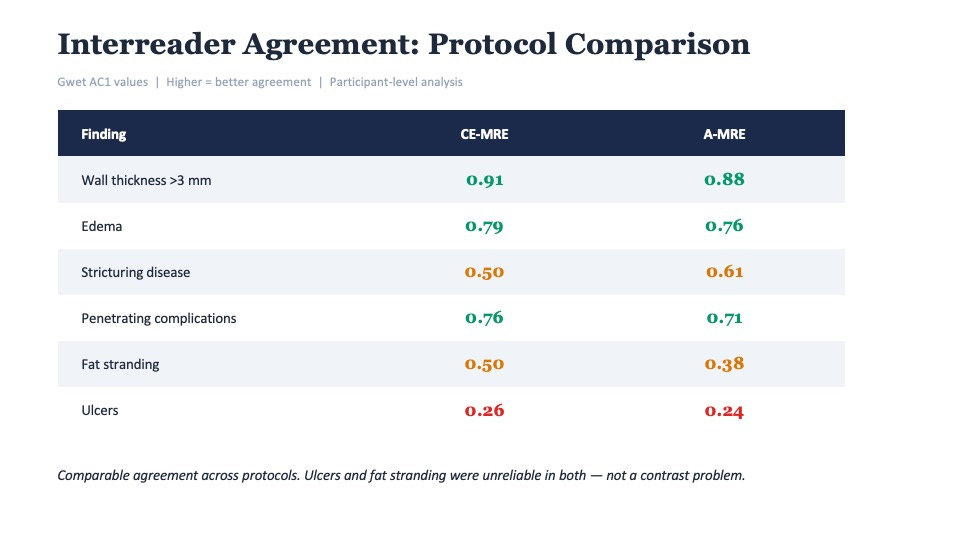
Wall thickening, the most reliable sign of active disease, was almost perfect in both protocols (AC1 0.91 with contrast, 0.88 without). Edema: 0.79 vs 0.76. Strictures actually scored slightly better on the abbreviated protocol. The simplified MaRIA score held up too, with 96% sensitivity for abbreviated vs 98% for the full protocol using ileocolonoscopy as reference.
Same reader, same case, two protocols: nearly identical calls every time, with intrareader concordance ranging from 0.86 to 1.00.
Two findings were unreliable in both protocols, ulcers and fat stranding. But that’s not a contrast problem. Those are hard to assess regardless of what sequences you have.
The practical payoff: dropping the T1 sequences and injection saves about 7.5 minutes per exam, roughly 40% of scan time. For patients getting MRE multiple times a year over years, that adds up. Less gadolinium exposure, better throughput, shorter time on the table.
Ohliger’s editorial proposes the sensible next step, a tiered approach. Use the abbreviated protocol for routine monitoring. Reserve contrast for equivocal findings or suspected penetrating complications. I think that’s the right framing.
Caveats worth keeping in mind: this was a simulated abbreviated protocol extracted from the full exam, not a truly separate acquisition. The readers had subspecialty expertise. And DWI was excluded, which many contemporary protocols include. Prospective validation is still needed.
But the direction is clear. Watch this space.
Watch the full episode: RadBrief EP01 on YouTube
Sources:
Rimola et al. “Comparison of Conventional versus Abbreviated MR Enterography.” Radiology 2026;319(2). PMID 42117993.
Ohliger. “Abbreviated MR Enterography in Crohn Disease: Is Contrast Necessary?” Radiology 2026;319(2). PMID 42117994.